
International 4700 Turbo Upgrade
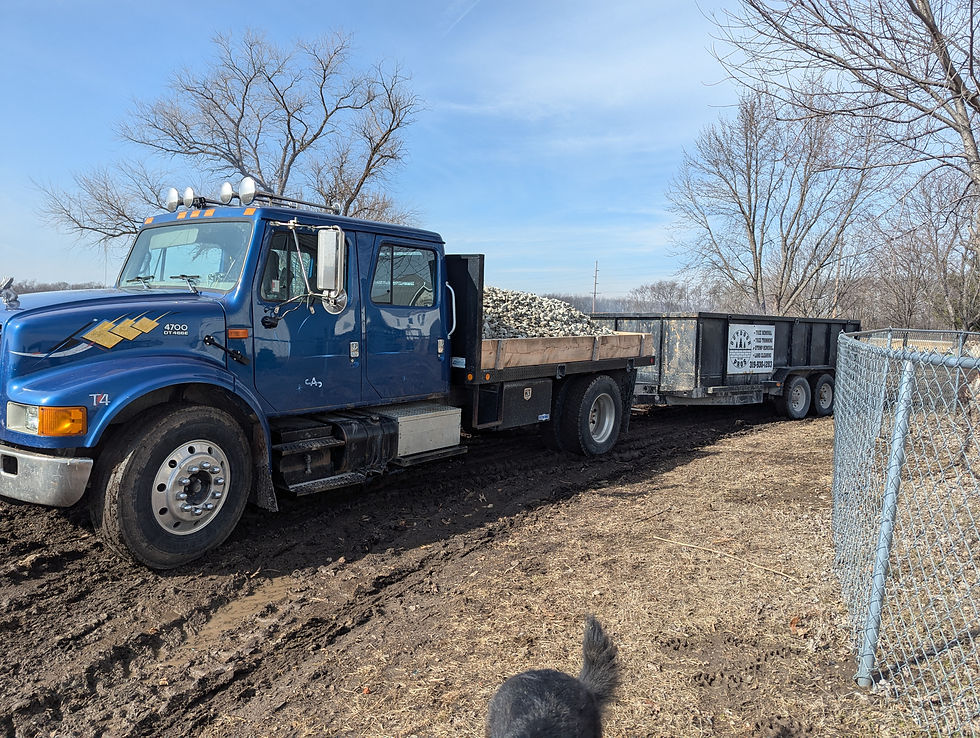
My truck was factory rated for 230 hp with a dt466e. This seemed sufficient for a little over 30k lbs. I did have it up to 40k once or twice though. I started with installing a power hungry performance tune to gain horsepower. Before I installed the PHP tune though I did install a pyrometer and boost gauge. With stock hardware I found the 250hp tune to be the safest. It would only get the pyrometer to 1200 degrees and it was a substantial step up in power and torque. I could move about 35k lbs with this tune comfortably and not have to watch any of the gauges at all. I ran this setting for 6 moths or so before going to the 275 tune.
The 275 tune gained a little bit over the 250 tune. It wasn't as substantial as going from 230 to 250. I have moved 40k lbs on this tune a number of times. As long as the load isn't horribly un-aerodynamic it does well on flat ground and gentle inclines up to 55mph. It does not like steep hills or interstate speeds loaded that heavy though. I did have to babysit the gauges a bit on the 275 tune. Running too hard too long and EGTs would reach over 1300 degrees. Id run it there while accelerating, but not for extended periods. The trick seemed to be that EGTs wouldn’t climb until I was past 2000rpm though. So cruising 55 was fine as long as I didn’t have to downshift. Overall, the 275 tune was good when loaded to 35k lbs or so but watching the pyrometer became a chore if I was loaded really heavy.
After installing the Borg Warner s363sxe turbo the 275 tune seems to have really woken up. I would compare the power gain to the difference that going from 230 to 250 made, but without even changing the tune. EGTs seem to be much better now too. I think they probably dropped a solid 150-200 degrees. I think I could probably get the pyrometer past 1200 with the new turbo still but I think it would take a lot to do it. My test run was with a skid steer and a total weight around 36klbs. I never exceeded 1200 degrees while accelerating to 55mph. I will definitely need to get some more miles on the new turbo to know for sure how much it helped, but I think the 275 tune will prove to be safe with any load now and I think it will also handle wind and hills fairly well. I tried the 325 tune with the new turbo and I was very disappointed to find it to be very smoky with very little power gain over the 275 tune. After a datalog I found the HPOP simply isn’t able to keep up and injection pressure is about 500psi short of what it should be. This led to very high EGTs. I haven’t tried the 300hp tune yet but I suspect it will be be just out of reach until I upgrade the fuel system. I think the turbo will hold up well to it though.

I decided to go with the s363 turbo to keep the low end power that I tend to rely on with the manual transmission. I was afraid going too big would sacrifice low end torque. This turbo spools a lot earlier and faster than the stock turbo though. I can make 20 psi of boost at about 1500 rpm. The stock turbo couldn’t do that until 2000rpm. It really doesn’t take anything to get it going. And it has a lot more top end too. I was making 29psi at 2500rpm with the stock turbo and I am making closer to 34 with the s363. After seeing how the 363 behaves I wish I had gone with the s366 turbo but I am still very impressed by what I have seen from the s363 so far.
The turbo install was actually very easy. Not quite bolt on, but not as complicated as most sources seemed to suggest it might be. The stock turbo and the s363 were almost identical in size aside from the new turbo lacking a wastegate. Before installing the new turbo I loosened the clamps on the back side of the housings holding the turbo together so I could rotate the 3 parts of the turbo to where they needed to be while installing it. The t4 divided flange bolted right onto the stock exhaust manifold. I was able to re-use the stock drain line as well. I did replace the o-rings on it, and I had to drill the mounting holes on the stock drain line block to fit the larger 3/8 bolts that the new turbo uses. The drain line just slipped right into the drain line block as I rotated it to the vertical position. No adjustments needed to get things where they need to be.

Then I tightened the clamps on the exhaust housing side of the turbo. The instructions that came with the turbo said to fill the turbo with oil before installing the oil feed line. It didn’t take much, and without any pressure it didn’t let the oil drain down either. The oil supply line needed two ¼ NPT male to ¼ JIC male adapters, one ¼ JIC male to female 90 degree fitting, and a ¼ hydraulic line. The hose was cut 25” long with a ¼ JIC female fitting on one end and a ¼ JIC 90 degree female fitting on the other end. I ran the line parallel to the block coming out of the oil supply port, then it curves under and around the turbo to the top. I was trying to avoid running it near anything hot.


With the oil line connected I got the compressor housing connected to the air intake hoses and tightened the clamps on the back of the housing. I did the downpipe modification next, which for me involved building a custom 4” downpipe. After doing it though I think the stock 3.5” pipe would be sufficient if its in good shape. The thing that needs changed though is the flange that connects to the turbo. The s363 has a 4.21” Marmon v band style outlet. The stock one looks very similar but its not the same, I’ve heard multiple people say it will leak if you don’t put the right flange on the downpipe.

With the downpipe installed I moved on to getting the air filter installed again, then getting things ready for the first startup. Per the manufacturer’s instructions, the turbo is not allowed to be put under a load for any amount of time without oil pressure. They want the engine to be cranked over without starting until the oil feed line is fill and oil is flowing through the return. I cant see if oil is returning or not. I unplugged the ICP valve so the fuel system couldn’t make pressure and the truck couldn’t start, then I cranked it over for about 10-15 seconds after I got oil pressure. I did this 3 times. This will cause an engine code for low injection control pressure. I wont trigger the check engine light though. Then plug the ICP valve back in and start the truck. This plug is on the left side of the engine on the fuel pump. I let it idle for 5-10 minutes before I took the truck for a drive. I took it really easy for the first 10-15 miles. Then I opened it up and let that turbo sing.

A couple notes on the gauges I have installed. The boost gauge was very simple to install. There's a port on the left side of the engine bay. Its 1/4npt and in the pipe from the intercooler to the engine if you have a 50/50 intercooler. Its in the top left of the full size intercooler. I don’t think its desperately needed. It is a good indicator of the power the engine is making though. If the engine is cold I usually can’t make full boost. If there's other engine problems it will likely show up in the boost pressure. I think running without it would be fine. I also installed the pyrometer before I ever tuned the truck. It measures exhaust gas temperatures, which are indicative of cylinder temperatures. It helps you know if you're about to melt a piston. 1200 degrees is the max I kept getting told for extended periods on this engine. I've ran up to 1400 for brief periods though. I typically keep it under 1300 though. The install location of the probe does make a difference in the temperature that gets read. I originally had the probe in the top of the manifold outside of cylinder 4. I eventually moved it down stream a couple inches closer to the turbo and it started reading 50 degrees or so cooler. I think this is a better spot for it. I moved it before installing the s363. I also have an exhaust pressure gauge. I think most people could go without this one. I like numbers though and its interesting to see what its doing. It did tell me that the stock turbo isn't really any more restrictive than the s363. They both had about 30psi driving them at full throttle and 2500rpm, the s363 does make more boost per pound of exhaust pressure though. I drilled and tapped the holes for both gauges with the stock turbo still installed. I used a vacuum to remove as many chips as possible while drilling, then I used grease on the tap to keep the chips stuck to it. Anything that fell inside got blown past the turbo when I started the truck. This method worked fine for me twice.

Overall the install time was only a few hours for the new turbo including the time it took to modify the downpipe. If I did it again I would most likely go with an s366 like people kept telling me to do. But initial impressions of the s363 are very good. I will have to see how well it holds up as I continue to upgrade the HPOP and injectors. Most of the cost of this upgrade was in the turbo itself at around $1300. the miscellaneous hardware was probably less than $100.
parts list and specs:
Turbo- Borg Warner s363 sxe, 0.91ar, T4 divided flange, 4.21” Marmon v band turbine outlet, 2.5” compressor outlet. Came from AGP turbo
Exhaust gasket- T4 divided, multi layer steel. Included with the turbo. Mine arrived bent.
Turbo drain gasket- included with the turbo.
Downpipe flange- 4.21” Marmon v band. Fits 3.5” or 4” pipes. Stainless. Came from AGP turbo.
Exhaust v band- 4.21” Marmon v band. Came from AGP turbo.
Oil line adapters- ¼” NPT male to ¼” or -4 JIC male. Need two. Came from my local hydraulic hose supplier.
Oil line adapter- ¼” JIC male to ¼” JIC female, 90 degree. Need one. Came from my local hydraulic hose supplier.
Oil supply line- ¼” hydraulic hose cut to 25”, ¼” JIC straight female swivel on one end, ¼” JIC 90 degree female on the other end. Came from my local hydraulic hose supplier.
Thanks to James Cefalo for some of the advice and the parts list.
Shoutout to AGP turbo for the fantastic customer service.
Comments